Butterflies of Houston and Southeast Texas by John Tveten
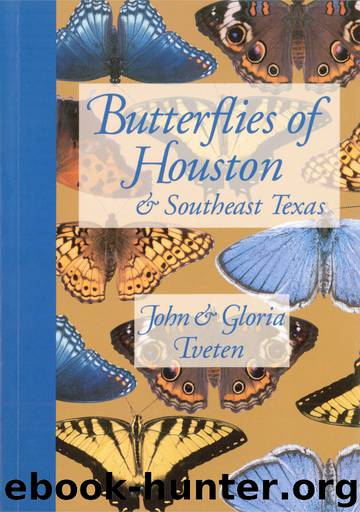
Author:John Tveten
Language: eng
Format: epub
Publisher: University of Texas Press
Published: 1996-12-08T05:00:00+00:00
Red Admiral
Vanessa atalanta
Alderman, Nettle butterfly
The red admiral can be confused with no other North American butterfly. Its velvety black forewing has white spots at the tip and a median band of bright red-orange. That color also borders the black hindwing, appearing to connect with the forewing band when the butterfly perches with wings spread wide. After flashing its bright colors as it darts rapidly about, the red admiral seems almost to vanish when it perches again and folds its wings. The dark hindwing below is cryptically mottled with brown and blue, while the forewing pattern is muted and less distinct. Sitting head downward on a tree trunk, this common backyard butterfly exhibits near-perfect camouflage.
The red admiral occurs throughout most of North America south of the high Arctic. It ranges from Alaska and Canada south through the U.S. and the highlands of Mexico to Guatemala. Other populations inhabit northern Africa, Europe, and western Asia, and introductions have established it in Hawaii and New Zealand. First described from Europe by Linnaeus in 1758, this beautiful butterfly takes its scientific name from classical mythology. Atalanta of Boeotia was the daughter of King Schoeneus. Her great beauty gained her many admirers, but she killed those she conquered in races. She was finally defeated by Hippomenes, whom she married.
Red admirals are territorial and highly aggressive, darting out to challenge passing birds and mammals as well as other butterflies. They frequently alight on humans, apparently taking salts from perspiration. Regular visitors to a variety of flowers, they also feed at tree sap, ripe fruit, and animal dung and sip moisture at mud puddles.
The female deposits her pale green, barrel-shaped eggs singly on leaves of host plants, but she may lay several eggs on the same plant. Nettles serve as the primary larval host, but false nettle and pellitory are also used. All are in the family Urticaceae. One would expect that the red admiral’s bright pattern provides a warning of toxicity, but Emmel (1991) reports that larvae and adults are not known to assimilate poisonous compounds from the stinging nettles.
Download
This site does not store any files on its server. We only index and link to content provided by other sites. Please contact the content providers to delete copyright contents if any and email us, we'll remove relevant links or contents immediately.
Sapiens: A Brief History of Humankind by Yuval Noah Harari(14389)
The Tidewater Tales by John Barth(12658)
Mastermind: How to Think Like Sherlock Holmes by Maria Konnikova(7342)
The Thirst by Nesbo Jo(6943)
Do No Harm Stories of Life, Death and Brain Surgery by Henry Marsh(6941)
Why We Sleep: Unlocking the Power of Sleep and Dreams by Matthew Walker(6721)
Life 3.0: Being Human in the Age of Artificial Intelligence by Tegmark Max(5557)
Sapiens by Yuval Noah Harari(5369)
The Body: A Guide for Occupants by Bill Bryson(5096)
The Longevity Diet by Valter Longo(5062)
The Rules Do Not Apply by Ariel Levy(4966)
The Immortal Life of Henrietta Lacks by Rebecca Skloot(4587)
Animal Frequency by Melissa Alvarez(4470)
Why We Sleep by Matthew Walker(4441)
The Hacking of the American Mind by Robert H. Lustig(4381)
Yoga Anatomy by Kaminoff Leslie(4363)
All Creatures Great and Small by James Herriot(4319)
Double Down (Diary of a Wimpy Kid Book 11) by Jeff Kinney(4268)
Embedded Programming with Modern C++ Cookbook by Igor Viarheichyk(4177)
